How to Choose the Right Sofa: A Practical 7-Step Guide


BUNISE · Sofa guide
Find the right size, layout, comfort and upholstery for your home.
Start with the people who use your sofa every day. Then check your room, compare how you like to sit, and look at the details behind the upholstery. This sofa buying guide helps you compare sizes, layouts, comfort and upholstery before ordering.
1. Choose the Right Size
How many people need a seat?
Use these approximate overall lengths to begin comparing straight sofas. All lengths include the armrests.
Two people
150–190 cm
Approximate overall length
Illustration example180 cm overall
Three people
190–240 cm
Approximate overall length
Illustration example220 cm overall
Four people
240–300 cm
Approximate overall length
Illustration example280 cm overall
Simplified illustrations of the same sofa design; lengths include both armrests. These are teaching examples, not measurements of a BUNISE product.
A starting point, not a seating guarantee. These overlapping ranges are an initial guide, not a fixed standard. Armrest width, usable seat width, body size and sitting preferences all affect how many people can share a sofa. Check the dimensions of the model and configuration you choose.
Overall length is not seating width
Overall length runs from the outside of one armrest to the outside of the other. Seating width is the usable space between the armrests.
For a simple example, a 220 cm sofa with a 20 cm armrest at each end leaves:
220 − 20 − 20 = 180 cm of seating width.
Divided between three people, that is about 60 cm each. This is a measurement example, not a promise that everyone will find it spacious. Allow more room when you prefer to spread out.
Measure the room, not just the wall
Measure the sofa area in both directions. Mark the proposed footprint on the floor, then check the main walking route, door swings, coffee table, TV cabinet and any side tables or lamps.
For example, a 340 cm wall with 40 cm reserved at each end leaves 260 cm for the sofa. You still need to check its depth and the space in front of it.
Your next step: Send us your available length and depth, together with a room photo or floor plan.
2. Choose Your Layout
Straight, chaise or modular?
| Layout to compare | Start here when… | Check before choosing |
|---|---|---|
| Straight sofa | You want one seating line and flexibility for separate chairs or tables. | Usable seat width and the route around each end. |
| Sofa with a chaise | Stretching out is part of your daily routine. | Which side the chaise occupies and whether its full depth blocks a route. |
| Modular sofa | You want to build a configuration around your room. | The exact modules, total footprint, connections and finished sides. |
Do not judge capacity by the number of cushions alone. A chaise for one person to stretch out on is not automatically an extra full upright seat.
Confirm the direction visually. A label such as “left chaise” can be misunderstood. Before ordering, confirm a plan-view drawing that shows which side the chaise is on and the viewpoint used.
Your next step: Pick a layout and check its footprint against your room measurements.
3. Find Your Comfort
Overall depth is not seat depth
- A · Overall depth
- The complete front-to-back measurement.
- B · Usable seat depth
- From the seat’s front edge to the back cushion where you sit.
- C · Seat height
- From the floor to the sitting surface.
Illustrative measurement definitions only. No universal ideal depth or height is implied.
Overall depth is the sofa’s complete front-to-back measurement. Usable seat depth is the space from the seat’s front edge to the back cushion where you actually sit. Seat height is the distance from the floor to the sitting surface.
Compare these measurements separately. Two sofas with the same overall depth do not necessarily offer the same usable seat depth.
Try the way you actually sit
For upright sitting, test the sofa with your back against the cushion and check how your feet rest. For lounging, try your normal relaxed position rather than judging from a quick sit on the front edge. Stand up again and decide whether the seat height and feel suit you.
When more than one person uses the sofa, compare it together. A cushion that suits one person may not suit another.
Softness and foam density are different. Density describes mass per unit volume; firmness describes surface feel. A higher-density foam is not necessarily harder. Compare the finished seat and the specification for the exact model rather than relying on a density number alone. [Source: PFA]
Your next step: Tell us whether you prefer upright sitting, relaxed lounging or a mix of both.
4. Choose Your Upholstery
Start with your household, not a material label
| Your priority | What to compare | What to ask us |
|---|---|---|
| Children or frequent spills | The exact upholstery sample and its care instructions. | Which cleaning method is suitable for this material? |
| Pets | Texture, snagging concerns and documented performance for the selected fabric. | What does “pet-friendly” mean for this specific option? |
| A removable cover | Which parts can actually be removed. | Is washing permitted, and under which care instructions? |
| A leather finish | The leather type, surface finish, feel and colour sample. | What routine care does this particular leather require? |
Do not assume that “removable” means machine-washable, or that a material description guarantees resistance to every spill or scratch. Confirm the selected upholstery’s instructions before cleaning.
View the actual sample with the other materials in your room. Treat screen images as a guide, then confirm the final material and colour code for your order.
Your next step: Shortlist two or three materials and compare their feel, appearance and care requirements.
5. Match Your Room
Compare proportion before picking a colour
Look at the sofa’s outline alongside the other furniture you plan to keep: arm width, back height, base, visible legs and cushion proportions. Compare these features in the context of the room, not only in an isolated product photo.
For colour, start with the fixed finishes—flooring, curtains, rugs and existing furniture. Decide whether the sofa should blend in or become the focal point. Then compare upholstery samples in the room.
When comparing colour options, use the same sofa and viewing angle wherever possible. That makes it easier to decide whether you are responding to the colour or to a different shape.
Your next step: Save a room photo and one or two reference images that show the feeling you want to achieve.
6. What’s Inside Your Sofa?
A closer look at a real BUNISE construction example
Russian pine wood frame · Spring support · Foam cushioning
The construction shown here combines a Russian pine wood frame, springs and foam. The photographs show the frame and underside before the base covering conceals these details. You can see the timber members, zigzag-shaped springs, support webbing and foam around the exposed perimeter.
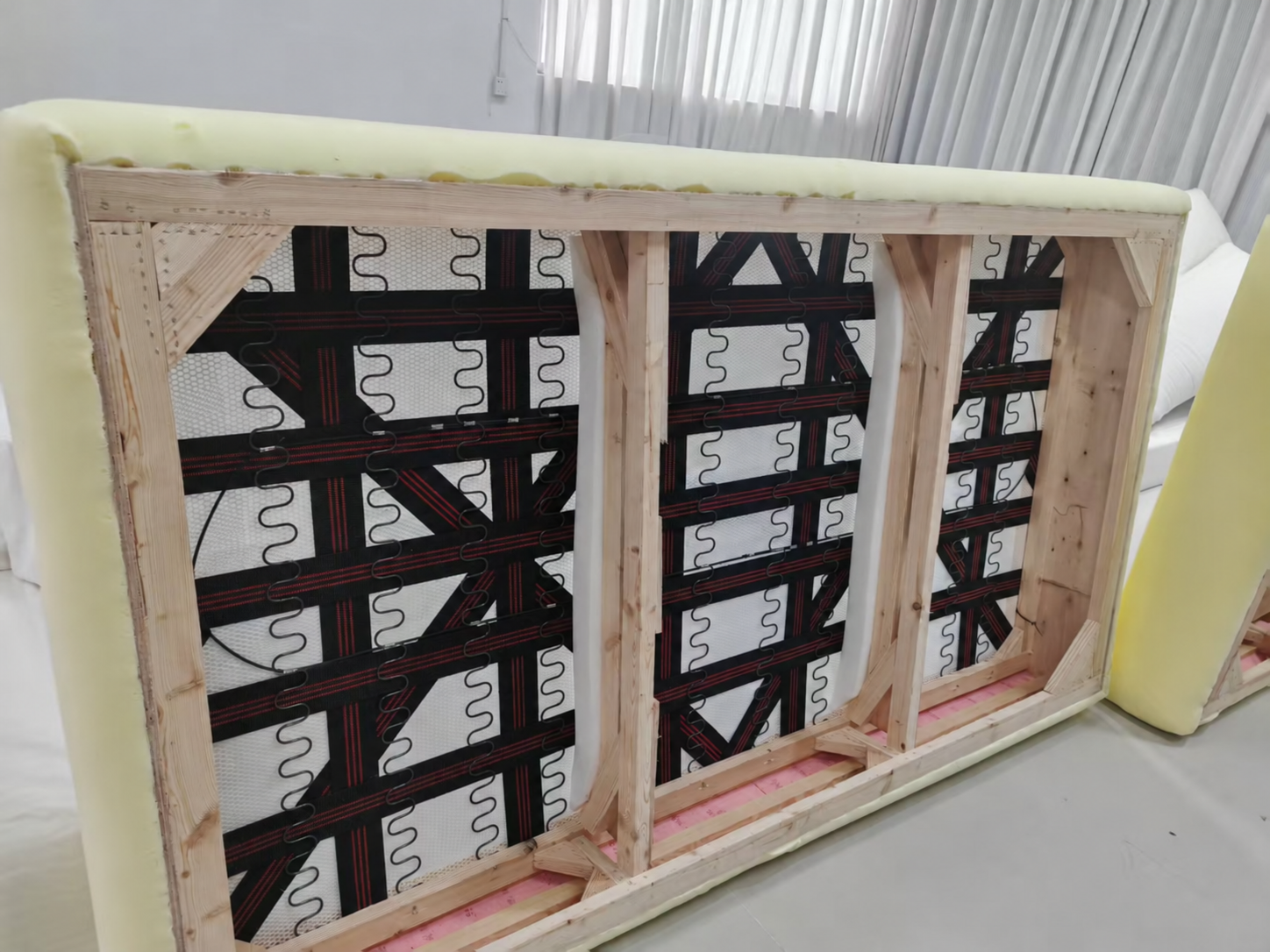
| Component | What this example shows or specifies |
|---|---|
| Russian pine wood frame | The specified timber frame for the construction shown. |
| Spring support | The zigzag-shaped springs visible across the base. |
| Support webbing | The black-and-red straps visible alongside the springs. |
| Foam cushioning | Foam is part of the confirmed specification; foam around the frame perimeter is visible in the photographs. |
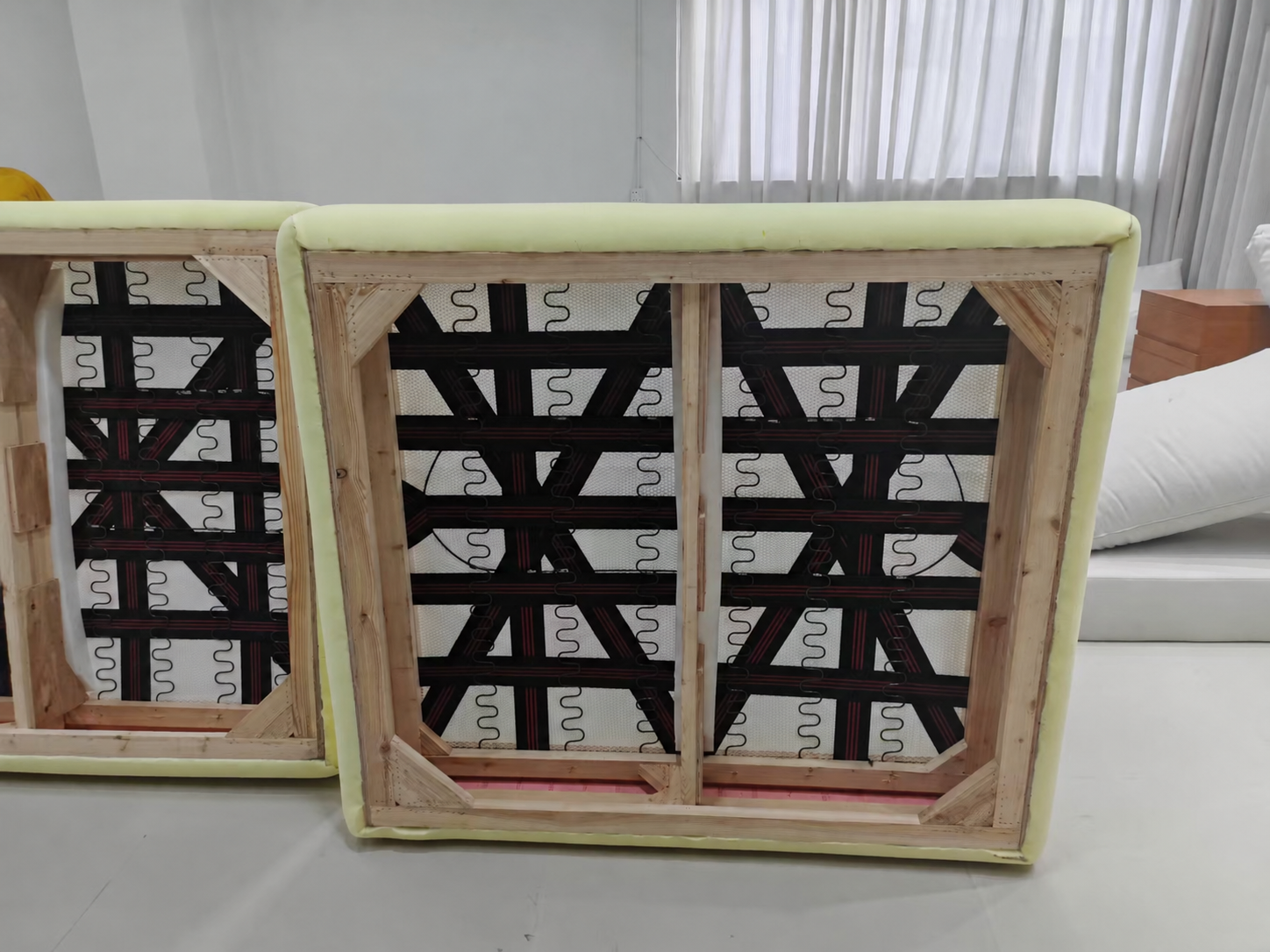
Ask about the complete specification
A construction photograph helps show details that are normally hidden, but it is not a substitute for the specification of your order. Ask which frame, support and cushioning are included in the exact model you are considering.
Your next step: Ask us to confirm the materials and construction for your selected sofa, rather than assuming every design uses the same build.
7. Check Before Ordering
Confirm the sofa and the delivery route
Your specification
- Model and configuration
- Overall length and depth
- Chaise direction
- Upholstery code and customisation
Your delivery route
- Entrances, corridors and turns
- Lift door and cabin
- Packaged or delivery-unit dimensions
- Parts that separate and reassemble
Your written terms
- Final price and tax treatment
- Estimated delivery window
- Payment, delivery and installation
- Warranty and care instructions
Before paying a deposit, check the model, configuration, overall length and depth, chaise direction, upholstery code and any agreed customisation.
Measure the complete delivery route: building entrance, lift door and cabin, corridors, staircase turns and the room entrance. Ask for packaged or delivery-unit dimensions, not just assembled dimensions. Where applicable, confirm which parts can be separated and reassembled.
Confirm what your quotation includes
Check the final price and tax treatment, estimated delivery window, payment terms, delivery and installation scope, warranty coverage and care instructions. Confirm any additional requirements—such as difficult access or old-sofa removal—before they become part of the order.
Your next step: Review the final written specification and service details together before approving the order.